Aerobotics and the Advent of Smart Farming in South Africa
How drones, artificial intelligence and agricultural data are transforming the way South African farmers monitor crops and make decisions
By Tsaone Segaetsho
For generations, farming has depended on the farmer's experience, eyesight and knowledge of the land. But increasingly, another set of eyes is watching the fields — drones and satellites, backed by artificial intelligence, machine learning and data analytics.
In South Africa, Cape Town-based agritech company Aerobotics has emerged as one of the notable companies driving this shift towards precision and smart farming.
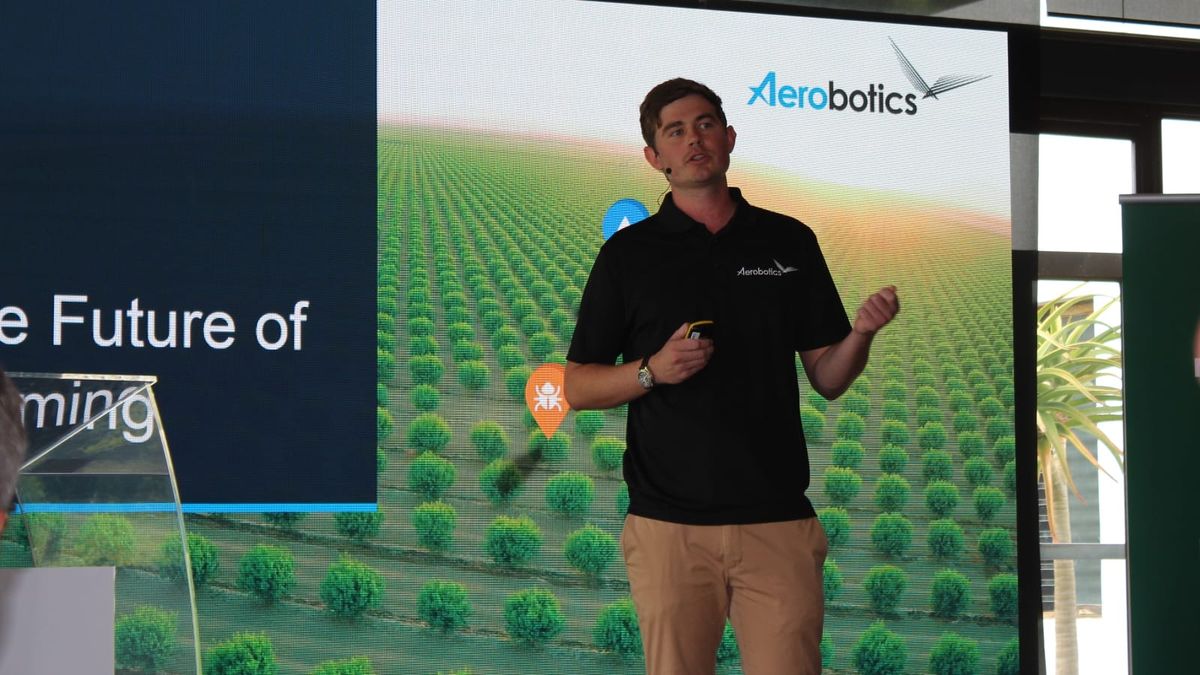
Founded in 2014 by James Paterson and Benji Meltzer, Aerobotics developed technology that uses aerial imagery and software to identify crop problems at an increasingly granular level. The company's approach has been particularly focused on tree crops and vineyards, where individual trees can be monitored as separate data points.
For Paterson, the connection between agriculture and technology is personal.
“I grew up on the farm and got to know the risks and the problems on the farm growing up,” he said in a 2018 interview with BizNews, explaining that his background in farming eventually intersected with his studies in aeronautics and astronautics at MIT.
That combination of farming experience and engineering became central to Aerobotics' proposition: use technology to give farmers a more detailed understanding of what is happening across their fields.
Seeing the farm from above
The company's technology uses drone and satellite imagery, with AI and machine learning applied to the resulting data.
Instead of simply producing aerial photographs, the system can turn individual trees into data points that can be monitored over time for changes in growth and health. Paterson explained that the technology could track the health of individual trees and compare them with other trees in an orchard.
That changes the way farmers can approach crop management.
Rather than treating an entire orchard as a uniform environment, growers can identify specific areas requiring investigation or intervention.
In 2018, Aerobotics launched a series of precision-agriculture innovations designed around early pest and disease detection. The company's Drone Scouting Application used AI to identify stressed trees and help generate scouting routes for drones.
Paterson described the ambition behind the technology in stark terms:
“We have been working extremely hard over the past few years with growers and industry partners to create technology that will completely change how farmers manage their crops, identify stressed trees and spot individual pests and diseases without stepping foot on the farm.”
He described the technology at the time as something that had been “the stuff of agritech legend”, arguing that the company was beginning to make that future a reality.
From images to intelligence
The significance of Aerobotics is not the drone itself.
The real value lies in converting imagery into actionable information.
A drone can capture thousands of images, but a farmer does not need thousands of photographs. What the farmer needs is an indication of where a problem exists, what may be causing it and where attention should be directed.
Aerobotics' system was designed to analyse imagery using AI and machine learning and alert farmers to potential problems. The technology could identify individual trees showing signs of stress and then direct further investigation towards those locations.
Paterson explained the concept in an interview with BizNews by describing the transformation of imagery into individual data points that could be tracked over time.
This is the essence of precision agriculture: replacing broad assumptions with increasingly precise information.
Towards the autonomous farm
Paterson's vision goes beyond drones being manually operated by pilots.
In his 2018 interview with BizNews, he outlined a future in which automated systems could monitor crops, detect pests and disease, count fruit and estimate yields before sending information to the farmer.
“I see it becoming more and more autonomous where the farmer doesn't even have to go out there and put the drone down,” Paterson said. “They just get a dashboard of information and the drones are going out to collect the required information automatically.”
That vision captures the broader direction of smart farming.
The farm becomes increasingly connected, with drones, satellites, sensors, software and AI feeding information into digital platforms. The farmer remains at the centre of the operation, but decisions can increasingly be supported by real-time and historical data.
A farmer-first approach
Aerobotics' development also illustrates an important lesson about agricultural technology: technology alone is not enough.
In a 2021 interview with AgFunderNews, Paterson described Aerobotics as a farming company enabled by technology rather than simply a technology company operating in agriculture.
That distinction is significant.
Agriculture is highly specialised. A system may be technically impressive, but it has to work within the realities of weather, pests, disease, labour, irrigation, crop cycles and farm economics.
Paterson's own background in a farming family has helped shape that perspective.
The objective is therefore not simply to put more technology on farms. It is to make technology useful to farmers.
Why smart farming matters in South Africa
South African agriculture faces a combination of pressures that make precision farming increasingly relevant.
Water availability, input costs, climate variability, labour requirements and the need to maintain export-quality crops all place pressure on growers to become more efficient.
For high-value crops, being able to identify a problem early can be particularly important.
A pest or disease issue identified at the individual-tree level gives the farmer an opportunity to investigate and respond before the problem becomes more widespread.
The same principle applies to yield forecasting.
Better information about crop development can help farmers plan harvesting, labour, logistics and market supply.
From precision to prediction
The evolution of agricultural technology is now moving beyond simply asking “What is happening in my field?”
The bigger question is becoming “What is likely to happen next?”
AI-powered analysis can potentially help farmers identify patterns in crop health and development, while historical data can provide a basis for comparing current conditions with previous seasons.
This is where smart farming becomes predictive agriculture.
The long-term ambition is a farm where information flows continuously between the physical environment and digital systems — where machines collect data, AI interprets it and farmers receive information that helps them decide where to act.
The challenge of accessibility
The rise of smart farming also raises a difficult question for Africa: who gets access to the technology?
Advanced drones, high-resolution imagery, connectivity, software subscriptions and skilled operators can be expensive. Much of the early adoption of sophisticated precision-agriculture technology has therefore been concentrated among commercial growers and high-value crops.
For South Africa, the next phase of the smart-farming revolution will need to address affordability, skills and access if the benefits are to extend beyond large commercial farms.
The opportunity, however, is substantial.
Technology that helps farmers use water, fertiliser, chemicals, labour and machinery more efficiently could become increasingly important as agriculture faces greater pressure to produce more with fewer resources.
The future is already above the orchard
Aerobotics' story illustrates how quickly agriculture is becoming a data-driven industry.
The drone flying over an orchard may look like the most visible symbol of this transformation. But behind it is a much larger technological ecosystem — satellite imagery, machine learning, artificial intelligence, cloud software, mobile applications and increasingly automated decision-making.
Paterson's early vision of a farmer receiving a digital dashboard while automated drones gather information points towards a future in which the farm is continuously monitored without requiring every problem to be physically discovered by walking through the rows.
For South Africa, that represents more than the adoption of another piece of technology.
It signals a fundamental change in how farming can be understood.
The farm of the future may still have tractors, workers, irrigation systems and farmers walking its fields.
But increasingly, it will also have a digital intelligence layer — constantly watching, analysing and learning.
And in that transformation, companies such as Aerobotics are helping South African agriculture move from precision farming towards a more predictive, connected and intelligent agricultural future.